
Top 10 Reasons Engineers Fail Their Skill Assessment and How to Avoid Them

Top 10 Reasons Engineers Fail Their Skill Assessment and How to Avoid Them
Would you like to migrate to Australia as an engineer? The most important stage of your immigration is your skill assessment. Whether you’re applying for the federal skilled worker program through Express Entry to boost your CRS score, or seeking Australia PR points to understand what you need to get into Australia, a failed skill assessment can set back your dreams.
Every year, thousands of engineers face rejection from Engineers Australia and similar bodies. Understanding the common mistakes engineers make in skill assessment and learning how to avoid rejection by Engineers Australia can save you months of delays and frustration. This comprehensive guide reveals the top 10 reasons engineers fail Skill Assessmentfor Australia and provides practical solutions to ensure your success.
🔑 Key Highlights
- Top 10 Common Mistakes that get use rejected in Skill Assessment
- How to avoid Skill Assessment Rejection
- Best practice to get your migration Success
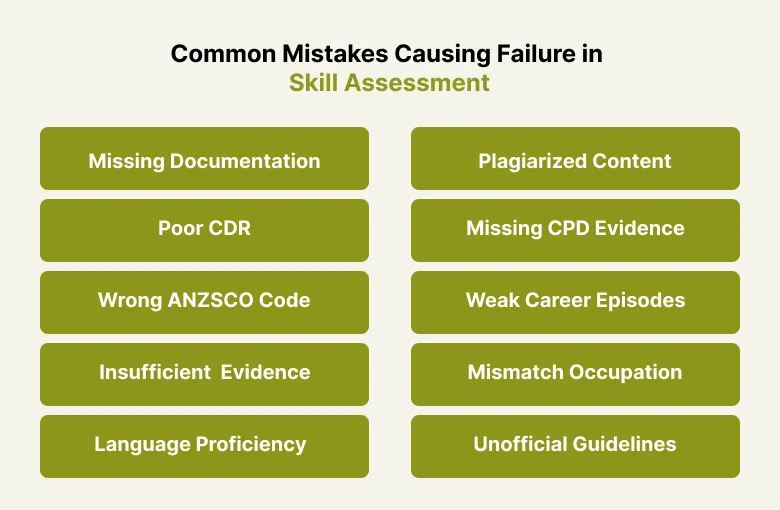
1. Incomplete or Missing Documentation
What happens: Your application gets rejected before it’s even properly reviewed.
Incomplete documentation is the number one reason why skill assessment gets rejected. A lot of engineers do not attach enough importance to the delivery of each and every document needed. The absence of any certificate, such as an employment letter or academic transcript, will lead to rejection.
The most common documents that are missing include:
- Tertiary transcripts and degree qualifications.
- Comprehensive work reference letters.
- Evidence of the English language competence.
- Passport and identification papers.
- CPD (Continuing Professional Development) records.
How to avoid this mistake: Create a comprehensive checklist before starting your application. Cross-verify each document against the official Engineers Australia requirements.Make sure that all the documents are certified copies, which are transparently translated in the case of necessity, and labeled. Professional services would ensure that you are sure that you have everything covered in your documentation before it is submitted to save you the embarrassment of being rejected due to incompleteness.
2. Poor Quality Competency Demonstration Report (CDR)
What happens: Your technical competency appears inadequate, leading to assessment failure.
The CDR is a report to demonstrate your engineering skills and experience. CDR rejection is also majorly caused by a poorly written CDR. Most engineers have been composing generic and vaguely written descriptions that do not show engineering competencies.
Common CDR mistakes:
- Talking technical jargon and not telling me what you are.
- Using passive voice rather than an active voice.
- Failing to link experiences to competency elements
- Not demonstrating problem-solving abilities
- Copying job descriptions instead of personal contributions
How to avoid this mistake: You should write your CDR in the first person, use I statements demonstrating clearly your role in projects. Pay attention to certain issues that you resolved, choices you made, and results that you attained. Every career episode has to be a story with a start, middle, and a conclusion. In case of having problems with CDR quality, a professional CDR writing service can help you to have a report that passes all the technical and formatting requirements, which would have a high probability of being approved.
3. Selecting the Wrong ANZSCO Code
What happens: You are refused employment, because your work is not found in accordance with the evidence that the company discovered.
Choosing an incorrect ANZSCO (Australian and New Zealand Standard Classification of Occupations) code is a grave error that has the potential to affect your Australia immigration points. Most engineers choose codes depending on the job titles, but not the duties they undertake.
Why does this happen?
- Misunderstanding ANZSCO code descriptions
- Choosing codes based on desired rather than actual roles
- Not reviewing the detailed task lists for each code
- The same ANZSCO code is assumed to mean similar job titles.
How to avoid this mistake: Be attentive to the descriptive ANZSCO codes and lists of tasks. Compare your actual daily responsibilities against the listed tasks. When you discover that more than 60 percent of your duties are compatible with a specific code, then most likely you are doing the right thing. Keep in mind such codes as 233211 (Civil Engineer), 233212 (Geotechnical Engineer), 233213 (Quantity Surveyor), 233214 (Structural Engineer), and make sure it is a real one in line with your experience. When you are confused about ANSCO Codes, seek guidance from professionals who understand ANZSCO classifications.
4. Insufficient or Inadequate Employment Evidence
What happens: The assessors are not able to confirm the work experience that you have alleged, thus you are rejected.
Your employment evidence must prove you’ve worked in engineering roles. Weak employment documentation is a major skill assessment rejection reason Australia faces frequently. Reference letters that lack detail or don’t meet specific requirements will cause immediate rejection.
Essential employment evidence requirements:
- Letters should be on the company letterhead.
- Include dates of employment (start and end)
- Specify job title and duties performed
- Show weekly working hours
- Include the supervisor’s contact information
- Bear company stamp and authorized signature
How to avoid this mistake: Get elaborate reference letters from all employers before quitting jobs. In case your employer is unable to send you a letter, come up with a statutory declaration with evidence such as pay slips, tax returns, employment contracts, and project reports. Make sure that letters are written with reference to engineering work, not to general descriptions of jobs.This evidence is crucial whether you’re applying for Express Entry or Australian immigration.
5. English Language Proficiency Issues
What happens: Your English qualifications are not up to the mark, and this turns your entire immigration process into a blockage.
The English proficiency is not limited to passing the IELTS or PTE, but also your capacity to work in an engineering environment that requires English as the language of operation. Low English scores reduce your CRS score for Australia PR points, and can result in skill assessment rejection.
Common problems:
- Failing to prepare in taking the test.
- Failure to pass the competent English (IELTS 6 in every band)
- Inability to provide sound test results.
- Test scores expiring before application completion
How to prevent such a mistake: Be ready with your English exam. You should get a high score above the minimum requirement, such as excellent English (IELTS 8) will give you a high CRS score and Australia immigration points. Prepare and take tests, and retake them in case your score is marginal. Keep in mind that the level of your proficiency in the English language is going to influence the quality of the skills you get rated and the success of your immigration process in general.
6. Mismatch Between Qualification and Nominated Occupation
What happens: Your degree doesn’t align with your claimed engineering occupation.
Assessors verify that your educational qualifications match your nominated occupation. A mechanical engineering degree won’t support a civil engineering skill assessment, regardless of your work experience. This mismatch is a common reason Engineers Australia skill assessment fails.
Why does this create problems?
- Different engineering disciplines have distinct competency requirements
- Your degree provides the foundation for your claimed expertise
- Assessors expect clear alignment between education and occupation
- Career progression should logically follow your qualification
How to avoid this mistake: Nominate an occupation that directly relates to your degree. If you’ve transitioned between engineering fields, provide clear evidence of additional training, certifications, or substantial supervised experience in the new field. Show progression through your career episodes that demonstrate you’ve gained relevant competencies despite the initial qualification difference.
7. Plagiarized or Copied Content in CDR
What happens: Immediate rejection and potential ban from reapplying for 12 months.
Plagiarism is taken extremely seriously by Engineers Australia. Copying content from samples, colleagues, or online sources is one of the most serious reasons for CDR rejection and can have long-lasting consequences.
Types of plagiarism that get detected:
- Copying from CDR samples or templates
- Using another engineer’s career episodes
- Copying and pasting from project reports without attribution
- Using the same CDR as a colleague with minor changes
- AI-generated content without proper personalization
How to avoid this mistake: Compose your CDR completely in your own language in accordance with personal experience. Although you might have collaborated with other people working on the same project, your opinion and effort must be different. Check with plagiarism detection software. In case you are having difficulties in organising your CDR, you can use the services of a professional to help you come up with original work that properly reflects your experience, as opposed to templates that will cause plagiarism cases.
8. Missing Continuing Professional Development (CPD) Evidence
What happens: Your application appears incomplete, showing a lack of professional growth.
CPD demonstrates your commitment to staying current in engineering practice. Missing or inadequate CPD is a frequently overlooked skill assessment rejection reason Australian engineers encounter.
CPD requirements typically include:
- Minimum number of hours (usually 150 400 hours, depending on experience)
- Variety of activities (courses, conferences, self-study, presentations)
- Recent activities within the last few years
- Engineering-related content
- Proper documentation and evidence
How to prevent such an error: Compose your CDR fully using your own words, depending on what you write out of personal experience. Although you may have worked on the same project as other employees, you are supposed to have a different view and contribute to the project. Check plagiarism using good plagiarism checking software prior to submission. In case you require assistance with organizing your CDR, you can use the professional services to help you produce original work that really reflects your experience, and does not give you a template whose use results in plagiarism problems.
9. Weak or Generic Career Episodes
What happens: Assessors cannot identify your specific engineering competencies from vague descriptions.
Career episodes are the heart of your CDR. Generic descriptions that could apply to any engineer fail to demonstrate YOUR unique competencies. This is among the top common mistakes engineers make in skill assessment.
Problems with weak career episodes:
- Describing what the team did instead of your contributions
- Using technical jargon without explaining concepts
- Failing to show engineering problem-solving
- Not demonstrating application of engineering principles
- Missing specific details about project parameters
How to avoid this mistake: The career episode should be presented as a narrative: Introduction (Background of the project), Background (Your job and challenges), Personal Engineering Activity (What you did in the episode), and a Summary (Results and what you learnt). Provide certain figures, data, and technicals. Demonstrate your application of knowledge and principles of engineering to resolve issues. Be able to show decision-making, analysis, and be innovative.
10. Not Following Official Guidelines and Format
What happens: Your application is returned or rejected for non-compliance with submission requirements.
There are formatting and submission requirements when submitting through Engineers Australia and other assessment bodies. Failure to observe them indicates irresponsibility and will lead to failure, no matter how qualified you are.
Common guideline violations:
- Exceeding word limits for career episodes (usually 1000 to 2500 words each)
- Incorrect document formatting or file types
- Missing required sections in CDR
- Not using prescribed templates or structures
- Submitting documents in the wrong order
- Failing to certify copies properly
How to avoid this mistake: Download and carefully read the latest Migration Skills Assessment Booklet from Engineers Australia. Follow every instruction precisely. Use the exact section headings required. Stay within word limits while providing sufficient detail. Have someone review your application for compliance before submission. Remember, these guidelines exist for both what you need to get into Australia and to ensure fair, standardized assessment of all applicants.
How to Avoid Skill Assessment Rejection: A Complete Action Plan
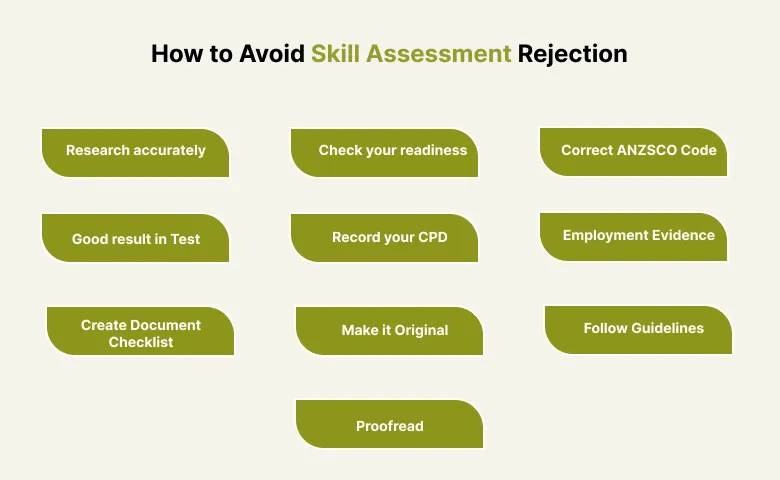
Now that you understand the common mistakes engineers make in skill assessment, it’s time to put together a winning strategy. Here’s your step-by-step action plan to avoid Engineers Australia rejection and secure your pathway to immigration success.
Before You Start Your Application
- Research accurately: Get the newest Migration Skills Assessment Booklet and read it all. Have the precise information on what you need to obtain into Australia, or are you qualified under the federal skilled worker program?
- Check your readiness: Check whether you have all the required documents, enough working experience, and a proper level of English proficiency. Disclose weaknesses in your application.
- Choose the right ANZSCO code: Spend time matching your actual job duties with ANZSCO descriptions. Don’t rush on this decision; it affects your entire application.
During Application Preparation
- Write a document checklist: In a list, the documents that are required are written, and the same are checked off as they get collected. Early certifying and translating of copies.
- Get ready for your English test: Do not take your test without preparation. CRS score and Australia PR points increase with increased English scores.
- Record your CPD: Prepare a list with all of your professional development activities and distribute them with supporting evidence. Arrange them in sequential order and explain each one of them.
- Gather employment evidence: Contact current and former employers early for detailed reference letters. Gather collateral information such as contracts, pay slips, and project documents.
Writing Your CDR
- Tell your story: Always write your career episode in first person, focusing on your specific contributions. Use the CAR method (Challenge, Action, Result) to structure your episodes in a proper format.
- Be specific and detailed: Omit no numbers, dates, technical specifications, or project parameters.
- Make it original: You have to write in your own words as per your real experiences. Check plagiarism prior to submission.
- Map to competencies: Be sure that every career episode is clear on which competency elements are needed by Engineers Australia.
FREE CDR SAMPLE!
Get Your Free CDR Report Samples
Quality Assurance Steps
- Guidelines compliance: Check that your CDR is within word limits, formatting requirements, and has all the required sections.
- Check proofread: Overproofread grammar, spelling, and technical accuracy. Have a second person look at your application afresh.
- Check completeness: Check your entire application one last time, just to be sure everything is included in it and that all the documents are certified.
Consider Professional Support
- Get professional advice: In case you are not sure about something on your application, professional CDR review services can also help spot the weak points beforehand. This is particularly useful to the engineers who have encountered previous rejection or have complicated employment histories.
Making a difference between success and failure is sometimes only a matter of paying attention and proper preparation. You are highly likely to avoid rejection and a step nearer to the goals of immigration by adhering to this action plan.
Take the Next Step Toward Your Immigration Goals
The skills assessment application should be prepared with attention to detail, skills in technical writing, and in-depth knowledge of the requirements in assessments. This guide offers the knowledge that you hope to get, but most engineers find this knowledge helpful with the help of a professional who can make sure that his application is perfect.
At ReportChamps, we specialize in making engineers follow the complicated process of skill assessment. Thousands of engineers have been assisted successfully by our competent staff to get their skill assessment in both Australia. We are aware of what assessors are looking for and how to make your qualifications shine the brightest.
And regardless of whether you require assistance with the CDR writing, RPL reports, career episodes, or overall review of your application, we have the professional assistance that can help you win or lose. Immigration dreams cannot be ruined by the usual pitfalls. These pitfalls can be avoided with appropriate preparation and professional advice, and help you reach your dream destination of being an engineer.
Your immigration journey starts with a successful skill assessment. Ensure that you do it the first time and do it correctly.
Frequently Asked Questions
Q: How long does skill assessment take?
A: Standard processing usually requires 12 to 20 weeks for Engineers Australia, but expedited options can be accessed.
Q: Can I reapply if my skill assessment is rejected?
A: Yes, however, you must resolve all reasons for rejection and may encounter delays, particularly if plagiarism has been identified.
Q: Do I need work experience for skill assessment?
A: For some routes, yes; others, no. New graduates can apply through specific categories, while seasoned engineers require detailed employment proof.
Q: What English test score do I need?
A: Basic proficiency in English (IELTS 6.0 in all sections), but higher results enhance your total immigration points.
Q: How important is the skill assessment for immigration?
A: It’s mandatory for both Canada’s Express Entry and Australia’s SkillSelect. You cannot move forward with your immigration application without it.
